Sheet metal welding is one of the most effective ways to create strong, permanent joints in thin metal components. Sheet metal can be manipulated in many ways: bending, curling, punching, stamping, and beyond. But sometimes manufacturers don’t need to cut or deform their sheet metal—they just need to fix two sheets together.
One way to join sheet metal is to use fasteners like screws and sheet metal rivets. Sheet metal fasteners are affordable, create strong connections, and can be easily removed for easy disassembly or recycling of sheet metal parts. They are also cost-effective when a project simply requires simple mechanical fastening.
However, manufacturers may desire a more permanent bond than a screw or rivet, or they may need their sheet metal joint to be ultra-strong or watertight.
For a strong, permanent, aesthetic joint, manufacturers typically turn to welding—a process that has existed for millennia. Welding sheet metal uses heat to melt and fuse two pieces of base metal, forming a strong joint without the need for extra parts.
Since there are many types of welding, this article looks at the best welding processes for sheet metal, including stitch welding, spot welding, MIG/TIG, and others. It looks at which welding techniques are best for different materials, gauges, and end-use applications, also providing a helpful welding types chart for quick decision-making.
Why Welding for Sheet Metal?
Welding sheet steel and other metals is a common process in shops and factories around the world—including at 3ERP, a reliable provider of sheet metal fabrication services.
This is partly because there are so many methods of welding, partly because there are many suitable sheet metals for welding, and partly because welding offers so many mechanical advantages. For example, stainless steel used in many welded structures provides corrosion resistance, making it ideal for outdoor or demanding environments.
Reasons for the popularity of welded sheet metal include:
- Several methods of welding: Different types of welding in sheet metal can suit different applications.
- Material versatility: There are many gauges and types of metal to weld, including steel, stainless steel, and aluminum.
- Strong, permanent joint: Unlike fasteners, welding creates a strong and permanent joint between two metal components.
- Water-tight and air-tight: Sheet metal welding can create a complete seal, making it suitable for tanks and enclosures.
- Aesthetic appeal: Some welding types can create a clean, aesthetic joint that maintains the aesthetic appeal of the metal.
- Part consolidation: Welding fuses two pieces of metal together rather than requiring a separate component like a fastener, potentially reducing cost and complexity.
Common Sheet Metal Welding Methods
Sheet metal welders must be skilled in various welding techniques, as different techniques suit different scenarios: Some are best for welding thin sheet metal, some are best for welding tiny parts, while some are particularly suited to certain types of metals used in welding.
In this section, we look at some of the top welding processes used at 3ERP for joining sheet metal parts.
MIG Welding (Gas Metal Arc Welding)
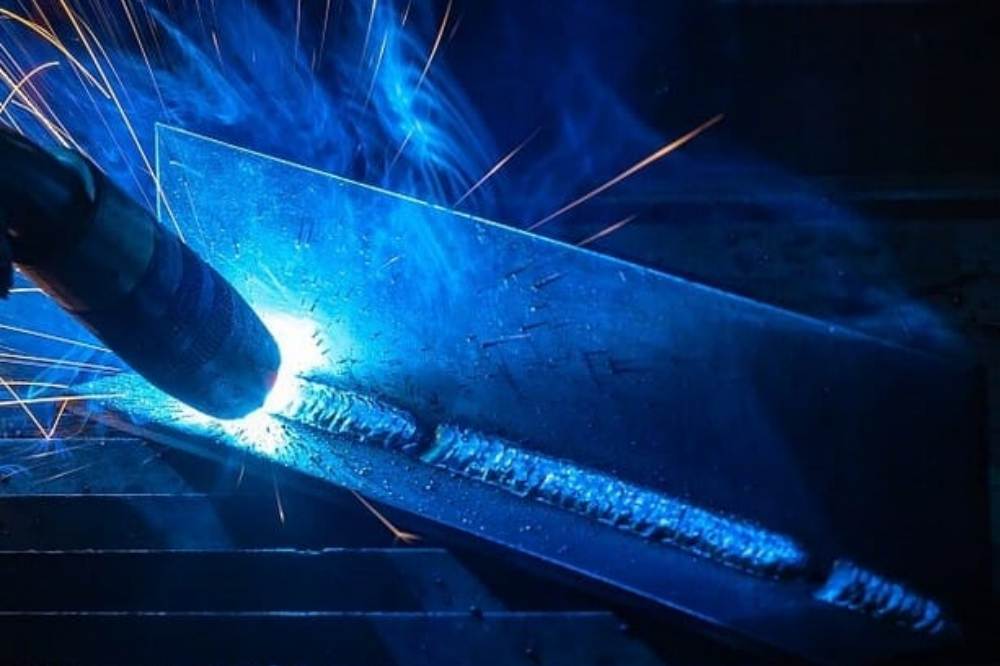
Pros: Fast, affordable, good for beginners
Best for: Mild steel, thick-gauge materials
Metal inert gas (MIG) welding is a subtype of gas metal arc welding (GMAW) that uses a semi-automatic or fully automatic arc to make a weld. MIG is a consumable electrode welding method, which means that the continuous wire fed through the welding gun functions as both the electrode carrying electricity and the filler metal forming the joint.
During the MIG process, the arc is formed between the tip of the wire and the surface of the sheet metal workpiece. This generates enough heat to melt both the wire and the sheet metal, allowing them to fuse together as they cool. The process offers good speed and reliability even on thicker materials.
The main advantages of MIG welding sheet metal are low cost, ease of use, and very fast speeds. The process is therefore ideal for sheet metal jobs that prioritize efficiency over precision or aesthetics.
Suitable MIG welding sheet metals include mild steel, stainless steel, and others, though thicker gauges of sheet are easier to work with.
TIG Welding (Gas Tungsten Arc Welding)

Pros: Precise, clean welds
Best for: Stainless steel or aluminum, thin metals, visible seams
Tungsten inert gas (TIG) welding or gas tungsten arc welding (GTAW) also uses an electric arc to melt sheet metal and form a weld. However, the TIG electrode is a non-consumable tungsten electrode that is separate from the consumable filler material.
To TIG weld sheet metal, the TIG welder uses one hand to feed the separate rod of filler material into the weld pool while using the other to direct the electrode. This makes the process more difficult than MIG welding, but it can lead to superior results.
The key benefits of TIG welding sheet metal include a high level of precision and a clean, aesthetically pleasing joint.
Possible TIG sheet metals include aluminum, titanium, and exotic metals, plus easier-to-weld metals like steels. TIG is also better than MIG at making welds on thin sheet metal and for welding visible seams.
Spot Welding
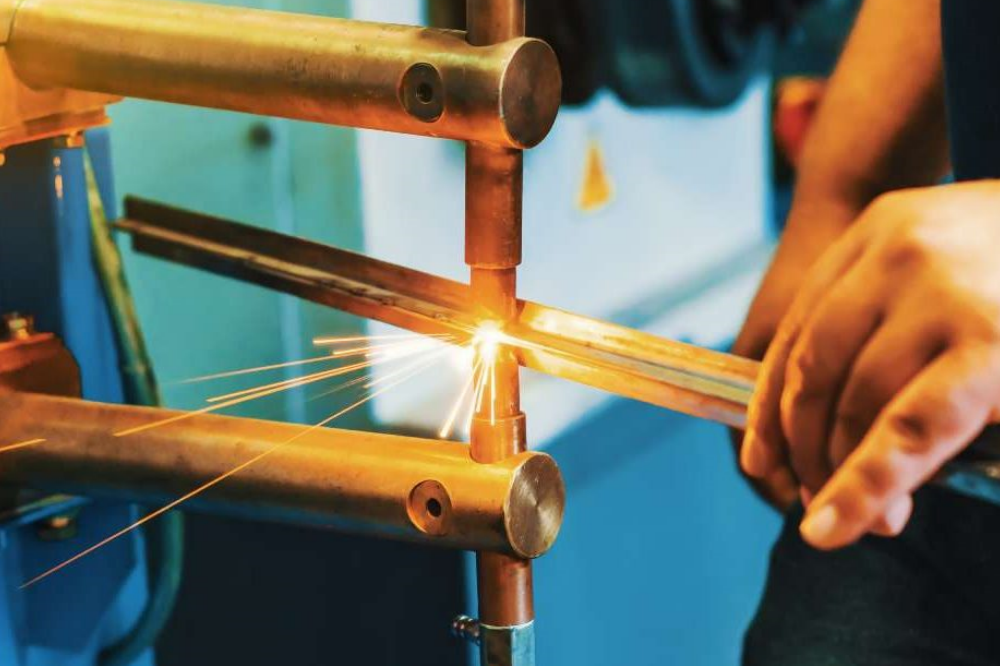
Pros: Automated, efficient for large-scale sheet joining
Best for: Automotive panels, mass production, thin-gauge sheet metal
Spot welding sheet metal is the process of creating very small welds between two pieces of sheet metal. It is a type of electric resistance welding.
During the spot welding process, two shaped copper alloy electrodes concentrate the welding current to create a “spot” between two overlapping pieces of sheet metal up to 3 mm thick, spaced 1 mm apart. The electrodes simultaneously press the sheets together to form the weld.
Spot welding advantages include fast speeds, limited energy use, and low deformation of the sheet metal workpieces. The entire process can also be automated and performed by robots. However, weld strength is low, and equipment costs can be high, and the process is not suited to thick sheet metal
One of the key applications of sheet metal spot welding is the mass production of automotive parts, with many cars having thousands of individual spot welds. In general, spot welding is suited to thin sheet metal, particularly materials like low-carbon steel, mild steel, stainless steel, and galvanized steel.
Stitch & Tack Welding
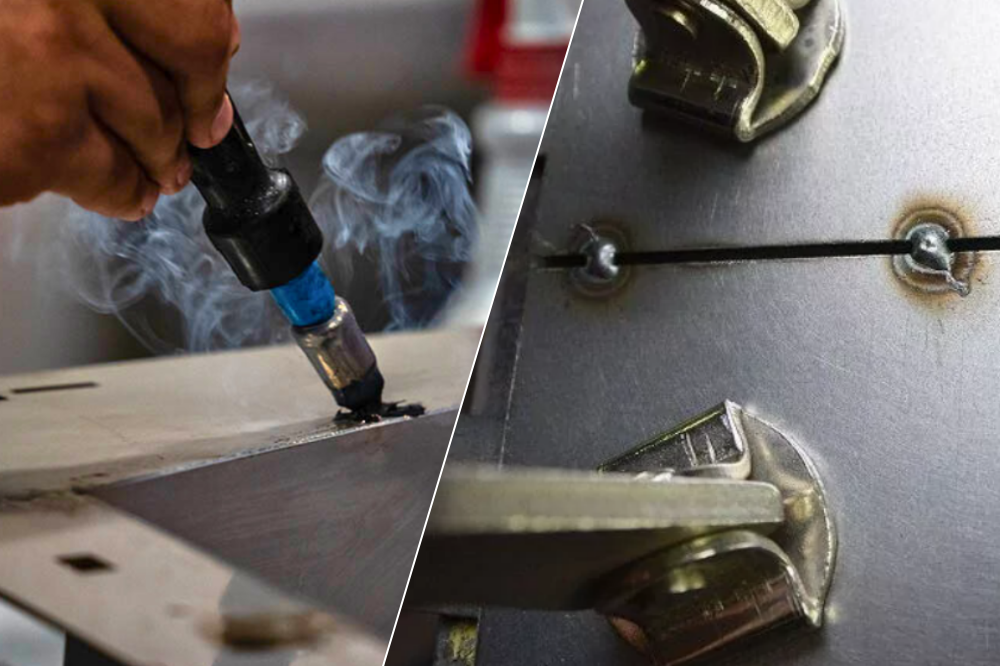
Pros: Low warping on thin metals, fast, easy
Best for: Non-critical or temporary joints, combining with MIG/TIG
Stitch welding and tack welding are two distinct but related welding processes for sheet metal. Stitch welding, also known as skip welding or intermittent welding, involves using a filler rod to make small joints between two pieces of sheet metal at regular intervals. It is used when a fully welded seam is not required.
Tack welding is another fast and efficient welding process for sheet metal. A tack weld is applied to attach two pieces of metal, forming a fairly weak bond but keeping the pieces aligned, usually so that a stronger connection can be made at a later stage. It resembles spot welding but does not create a strong, permanent bond.
Stitch and tack welding benefits include speed, low cost, and low difficulty level. However, welds are not strong or watertight.
Both processes are fairly versatile in terms of workpiece material, and both are suitable for making non-critical joints at speed. Tack welding is typically combined with a more high-strength welding process like MIG/TIG, which can be performed further down the line.
Plasma Arc Welding

Pros: High precision
Best for: Aerospace, electronics, precision fabrication
Plasma arc welding (PAW) is a form of arc welding closely related to GTAW/TIG. The electric arc is made between a tungsten electrode—located within the torch body—and the sheet metal workpiece. The placement of the electrode within the torch separates the plasma arc from its shielding gas envelope.
During the sheet metal plasma arc welding process, the current can be adjusted to suit different gauges. The hot plasma melts the two sheets together, forming a strong and precise joint.
Benefits of plasma arc welding include a high level of precision, fast speeds, and low power demands. Aesthetic quality of the finished welds is also high. However, it is one of the more expensive welding processes.
Plasma arc welding is ideal for sheet metal joining applications that require very thin sheets. It offers very fine control with low distortion risk. It is effective even when welding materials sensitive to excessive heat. It is one of the top welding processes used in precision manufacturing, particularly in areas like aerospace, electronics, and healthcare, or for welding reactive metals.
Other Welding Techniques
A large variety of welding processes can be used for sheet metal applications. Other sheet metal welding techniques include:
- Fuse Welding: Fuse or fusion welding melts two workpieces together, creating watertight but rough-looking welds on steel or stainless steel.
- Seam Welding: Seam or fillet welding is an arc welding technique that creates a long, continuous weld along a seam between two sheets. In sheet metal seaming, the joint is strong and watertight but risks workpiece deformation and requires significant cleanup.
- Electron Beam Welding: Electron beam welding is a high-cost process that uses an electron beam heat source to fuse the sheet metal pieces with high accuracy, even on difficult materials.
- Laser Welding: Laser welding works in a similar way to electron beam welding, producing comparable results. It is slightly more versatile but offers less penetration.
Sheet Metal Welding Comparison Table
The table below shows how some of the top sheet metal welding processes compare in terms of job cost, weld strength, welding speed, and aesthetic quality. For a more detailed examination of how to choose the right welding technique, consult the following section or speak to an expert at 3ERP.
| MIG | TIG | Fuse | Spot | Tack | Stitch | Seam | Plasma | |
| Cost | Low | High | Low | Low | Low | Low | Medium | Medium |
| Strength | High | Very high | Medium | High | Low | Medium | High | High |
| Speed | High | Low | Medium | Very high | Very high | High | High | High |
| Finish | Medium | High | High | Low | Low | Medium | High | Medium |
How to Choose the Right Welding Method
Choosing the right sheet metal welding method depends on factors such as the type of sheet metal, its gauge (thickness), the scale of the job (i.e., how many pieces must be welded), and the required weld type.
Material Type and Gauge
Some sheet metal welding techniques are better suited to certain metals and alloys. For example, while mild steel can be welded by most welders, a material like aluminum responds best to a process like TIG due to its use of AC current and high level of precision.
- Mild steel: Most welding processes
- Stainless steel: TIG, MIG, spot welding
- Aluminum: TIG, laser beam welding, electron beam welding
- Copper, brass, bronze: MIG, TIG
- Titanium: TIG, spot welding, seam welding
Some welding processes should not be used with certain metals. For example, highly reactive metals like aluminum and titanium are generally not suited to stick welding or even MIG welding. And most welding processes will fail to properly weld two separate metals with very different melting points—aluminum and steel, for example.
Sheet metal gauge also matters. For thin sheets, precision processes like TIG perform best, running minimal risk of deformation. However, other processes like MIG and stitch welding can also be used.
Thicker sheets are suited to processes like MIG and plasma arc welding, as well as other techniques like flux core arc welding and stick welding.
Production Scale
The scale of production impacts the choice of sheet metal welding process. Some processes are best for one-off parts or small batches, while others are suited to mass production.
On the whole, manual welding methods like MIG and TIG are better for smaller jobs. Access to manual equipment and manual labor is comparatively low, and the cost-per-part is reasonable even in small quantities.
For serial or mass production (1,000+ parts), other option should be considered. One such option is spot welding; although this requires some manual work, it is incredibly fast, allowing for high throughput even in large volumes, hence its popularity in the automotive industry. The process can be automated to further increase speed.
Other processes that can be automated at factory scale include robotic MIG, laser welding, and electron beam welding.
Preferred Joint Design
As specified by the American Welding Society (AWS), the five main types of weld joints are Butt, Lap, Corner, T (Tee), and Edge joints. Different welding processes can be better for achieving these specific joint types.
Some example processes are listed below, although skilled welders will be able to execute most joint designs with most processes.
- Butt joints: Where two pieces of metal are joined edge to edge in the same plane, TIG excels because of its precise heat control, while MIG and fuse welding serve well when speed matters more than appearance.
- Lap joints: Where two sheets overlap, faster and less precise techniques can be used such as MIG and spot welding.
- Corner joints: Where two sheets meet at a corner, TIG again excels, though other processes like MIG can also be used. Plasma arc welding is another option.
- T joints: Where one sheet is positioned 90° from another to form a T shape, MIG and stitch welding are both viable options.
- Edge joints: Where sheets are joined at flanging edges, are suited to processes like TIG and seam welding.
Sheet Metal Welding Tips and Tricks
Knowing how to weld sheet metal requires good knowledge of the chosen welding technique, as well as specific considerations relating to sheet metal (in comparison to other workpiece forms). Although long books can be written on any individual welding process, we have listed a few key tips and tricks for sheet metal welding below:
- Control the heat: A central aspect of successful welding, thermal control can be achieved in different ways. Some processes like stitch welding allow for quick intermittent breaks that allow heat to dissipate; other strategies for heat control include maintaining a quick and consistent travel speed, using copper heat sinks, or welding at a downward angle.
- Defect prevention: To minimize welding defects in sheet metal parts, it helps to thoroughly clean the workpiece, use a bone-dry filler material (ideally containing a low amount of hydrogen), select a shielding gas compatible with the chosen method and material, and design the parts and their joints well—even using welding simulation software to create the perfect weld.
- Warp reduction: Welders have a few strategies at their disposal to minimizing warping of metal sheet. For example, backstep weldingor backstepping is a technique that involves welding short segments of a joint then moving backward to start the next segment, overlapping and tying into the previous weld.
Expert Welding Services
Welding is a difficult skill to master, and a skilled welder can be the difference between poor-quality and high-quality sheet metal parts. That’s why many engineers and product designers turn to the expert welding services provided by 3ERP, a specialist in sheet metal fabrication and other types of low-volume manufacturing.
Accumulated over many years, our experience in sheet metal fabrication has seen us produce parts across diverse industries, from aerospace to consumer goods. We can also work with most sheet metals, including steels, aluminum alloys, and copper alloys.
In addition to our sheet metal welding services, we can also handle other aspects of sheet metal manufacturing, including many deformation and cutting processes, in addition to metal finishing procedures like polishing, abrasive blasting, plating, and painting.
For your next sheet metal welding project, request a quote from TDB.
Frequently Asked Questions (FAQ)
What is sheet metal welding?
Welding is a type of heavy duty sheet metal joining in which heat and a filler material are used to firmly attach two pieces of metal, fusing them into a single structure.
Which type of weld is generally used for thin metals?
TIG is ideal for fusing very thin-gauge sheet metal due to its high level of precision. Plasma arc welding is another option for thin metals.
What are the 5 types of weld?
According to the American Welding Society (AWS), the five main types of weld joints are Butt, Lap, Corner, T (Tee), and Edge joints. Joint types are distinct from the welding processes used to make them.
How to prevent warpage and distortion when welding sheet metal?
Sheet metal warpage can be prevented in several ways. Important steps include heat control (with short welds or backstepping, for example), use of fixtures and clamps, and advance prediction of shrinkage.
How to weld steel to steel?
Several welding techniques can be used to weld steel sheet to steel sheet, including MIG and TIG welding.
Can you weld aluminum with a flux core welder?
It is very difficult to weld aluminum with a flux core welder due to the large amount of spatter produced. MIG and TIG provide gas shielding to prevent this.
What are the best sheet metal fastening methods?
It depends on the type of joint required. Fasteners like bolts and rivets are fairly secure and can be undone, which is helpful for part repair, disassembly, and recycling. However, welding can create strong, watertight, and permanent joints, which are often preferred. Other techniques include adhesives, clinching, and hemming, all of which have their pros and cons.
What are the safety precautions for sheet metal welding operations?
Welding safety precautions include PPE (helmet, gloves, flame-resistant clothing), proper ventilation to control fumes, fire prevention steps, equipment checks, and other hazard prevention protocols.
What is the difference between spot welding and seam welding?
Spot welding is used to create a series of individual weld nuggets between overlapping sheets using electrodes and pressure. Seam welding rolls a continuous wheel electrode across the joint, producing a long, sealed, weld that is watertight.
Which welding process gives the cleanest finish on sheet metal?
TIG welding generally produces the cleanest, most cosmetic finish because—in the hands of an expert welder—it offers precise control with minimal spatter. Fuse welding and laser welding can also produce very clean results when the joint fit-up is perfect.
Can stainless steel sheet be welded without distortion?
Not really, but distortion can be minimized. Stainless steel conducts heat poorly, so techniques such as pulse TIG, staggered stitch welds, heat sinks, and clamping help control expansion and contraction.